DTI Return Policy in the Philippines (2026 Guide)
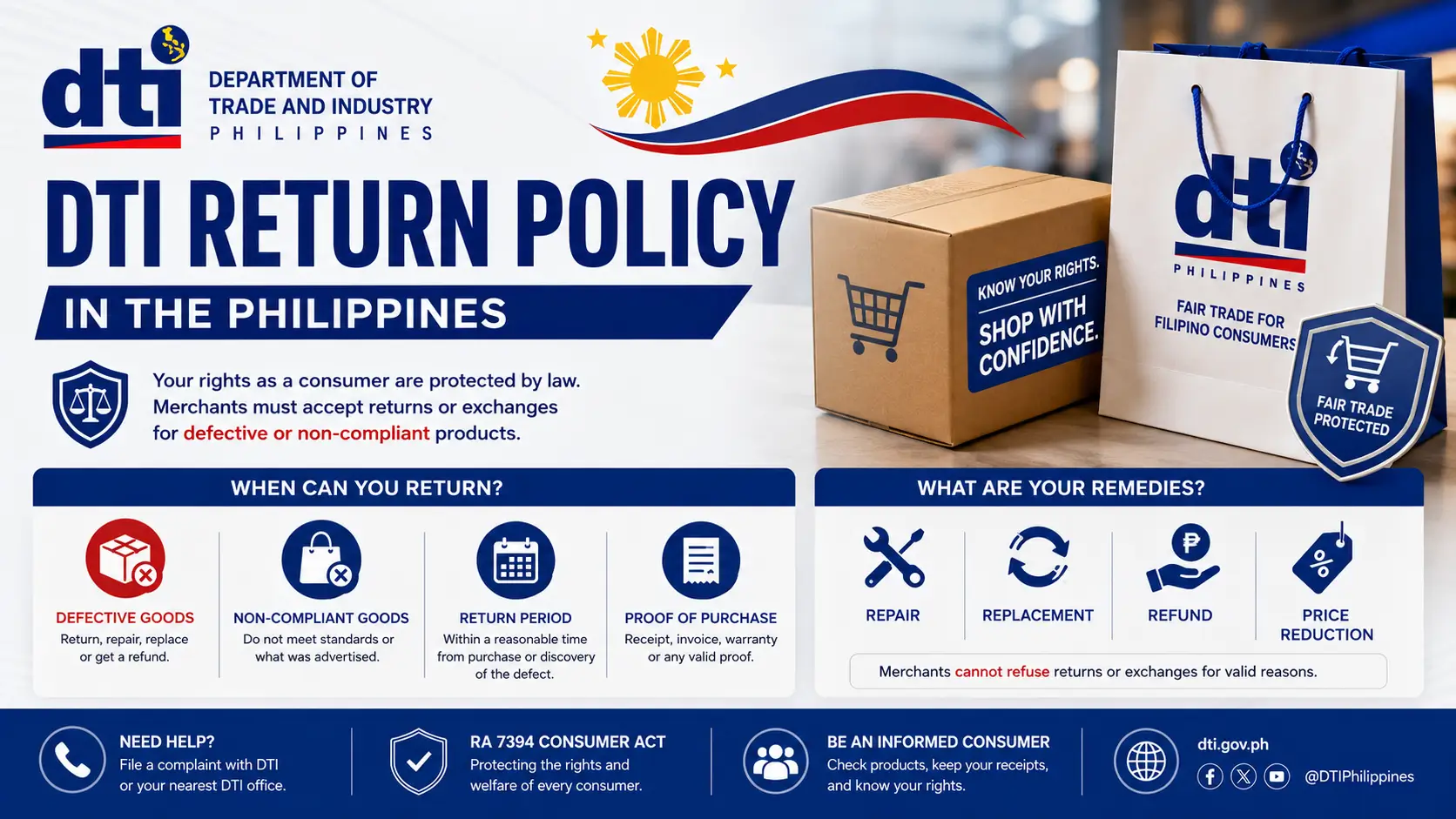
The Philippines’ Department of Trade and Industry (DTI) does not run one return policy for every store. Under the Consumer Act (RA 7394), no shop can post or print “No Return, No Exchange”, and you are entitled to repair, replacement or refund when a product is defective. You can claim with a receipt, or without a receipt if you can prove the purchase in another way. A change of mind, wrong size or wrong color is not covered by law, unless the store offers a goodwill return.
This guide explains exactly what the DTI rules say, what to do with and without an official receipt, and how to file a complaint if a seller refuses. It also covers online orders, the “no video, no refund” practice, warranty periods, medicines, brand-new cars and a ready-to-use demand letter.
DTI Return Policy at a Glance
| Situation | Can you return it? | What the rule says |
|---|---|---|
| Product is defective or has a hidden fault | Yes | Repair, replacement or refund under RA 7394 |
| Item is fake, expired or not as described | Yes | Remedies under RA 7394 and the Civil Code |
| Medicine was adulterated, misbranded, counterfeit or expired at purchase | Yes | Seller must replace it |
| You changed your mind | Not by law | Only if the store offers a goodwill return |
| You picked the wrong size or color | Not by law | Only if the store offers a goodwill return |
| Online seller says “no video, no refund” | Yes, for defective items | DTI treats this as a deceptive sales practice |
| You lost the receipt | Possibly | Other proof of purchase can be used |
Is “No Return, No Exchange” Legal in the Philippines?
No. The DTI says the phrase “No Return, No Exchange”, or any words to that effect, cannot be written into a sales contract, a receipt, a sales document or anywhere in the store. It treats this as a deceptive sales act under RA 7394.
The rule is found in the Consumer Act’s implementing rules, specifically Title III, Chapter I, Rule 2, Section 7 of DAO No. 2, series of 1993. The reason is simple. Such a sign leads buyers to believe they have no remedy for defective goods, which is not true.
DTI offices have repeated this warning many times. The DTI Region 1 office issued a reminder in June 2025, and a June 2026 report again quoted the DTI on the same point.
What the DTI Return Policy Covers
The key idea is that the law protects you from defects, not from regret. Here is what you can generally claim for.
- Hidden faults or defects that existed at the time of sale
- Goods that break down under normal use within the warranty period
- Counterfeit, expired or misbranded products
- Items that do not match what was advertised or promised
- Charges you were not told about at the time of purchase
You can ask for repair, replacement or refund. These are often called the 3Rs.
When a Store Can Refuse a Return
A seller can lawfully say no when the product is in good working condition. The DTI has said consumers are not entitled to a replacement or refund for a change of mind or their own mistake.
- You changed your mind about a working product
- You ordered the wrong size, color or model
- You found the same item cheaper elsewhere
- The damage was caused by misuse or mishandling
- The item was sold “as is” with the condition fully disclosed
Even then, a hidden defect can still support a claim. Many stores choose to accept change of mind returns as goodwill, but that is the store’s own policy and not a legal duty.
DTI Return Policy With Receipt
An official receipt or sales invoice is the strongest proof of purchase. With it, you can take the item back to the store where you bought it and ask for the remedy you prefer.
Steps to Return a Defective Item With a Receipt
- Stop using the item and keep all packaging and accessories.
- Take clear photos or a short video of the defect, including the serial number.
- Bring the item, the receipt and any warranty card to the store.
- State the remedy you want: repair, replacement or refund.
- Ask for the manager or the store’s customer service desk if staff refuse.
- Get any promise in writing before you leave.
Receipt or Warranty Card Is Enough
Under the warranty rules of the Consumer Act, you only need to present the product with either the warranty card or the official receipt to the seller. The DTI consumer education page summarizes this as having a receipt or warranty card being enough to claim.
DTI Return Policy Without Receipt
You can still claim without an official receipt. The DTI says the receipt is the best proof of purchase, but if you do not have one, you may use other proof that you bought the item from that store.
Alternative Proof of Purchase
| Type of proof | Examples |
|---|---|
| Payment records | Credit card statement, bank transfer record, e-wallet history, copy of a check |
| Online records | Order confirmation, email, chat messages with the seller, screenshots of the listing |
| Product records | Warranty card, serial number that matches the seller’s records, packaging |
| Other evidence | Photos taken at the store, delivery receipt, consistent witness statements |
Success depends on how strong your documents are. The DTI can mediate even when you have no receipt, but a weak paper trail makes the case harder.
Can a Store Demand a Receipt for Every Exchange?
Not always. According to DTI guidance, a store cannot make a valid receipt an absolute condition for exchange when the product is made or sold exclusively by that company, since the purchase can be proven in other ways.
How Long Do You Have to Return a Defective Product?
There is no single fixed deadline. The DTI applies a rule of reason, which looks at the type of item and the warranty that applies. The sooner you report a problem, the easier it is to show the defect was there at the time of sale.
Warranty Periods Under RA 7394
| Type of warranty | Period |
|---|---|
| Express warranty (stated by the seller or manufacturer) | Whatever the warranty states |
| Implied warranty of merchantability that comes with an express warranty | Same length as the express warranty |
| Other implied warranties on new consumer products | Not less than 60 days and not more than 1 year after the sale |
| Service firms, workmanship and replaced parts | Not less than 90 days |
A DTI official has also said that when no warranty card is given, the implied warranty is good for 60 days or up to one year. Some merchants offer as long as 180 days, and the DTI has mentioned seven days as a commonly seen minimum for merchant warranties.
Product Imperfections and the 30 Day Repair Window
For product imperfections, the Consumer Act lets the supplier fix the problem within 30 days. The parties can agree on a different period, but it cannot be shorter than 7 days or longer than 180 days. If the problem is not fixed in time, you can choose a replacement, a refund or a proportionate price reduction.
Can a Store Limit You to One Exchange?
No. A store cannot say a defective item can be exchanged only once. If the replacement is also defective and you choose replacement, the exchange can be repeated.
DTI Rules on Returning Medicines
Drugstores are one of the most common sources of return complaints. The rules are specific.
- The seller must replace medicines that are adulterated, misbranded, counterfeit or expired at the time of purchase.
- If the medicine has no such problem, the seller can refuse a replacement or refund.
- A seller may still choose to replace or refund as a goodwill gesture.
Online Shopping Returns and Refunds
The Internet Transactions Act (RA 11967), signed in December 2023, supplements the Consumer Act for online purchases. Online consumers keep the right to repair, replacement, refund or other remedies when a product is defective, lost without their fault or does not match the warranty or contract.
When you choose replacement or refund, the merchant may ask for the original goods back. The law says this return should be at no cost to you, within a reasonable period, unless you agreed otherwise. The online merchant carries the primary liability for problems arising from the transaction.
Use the Platform First, Then DTI
Before going to a court or government agency, you must use the seller’s or platform’s internal complaint process first. That process is considered exhausted if the issue is still unresolved seven calendar days after you file it. Keep your ticket number, screenshots and all replies, because DTI will ask for them.
What About “No Video, No Refund”?
Many online sellers print this note on parcels and refuse to help without an unboxing video. The DTI says a “no video, no return, no exchange, no refund” policy is a deceptive, unfair and unconscionable sales practice under RA 7394.
An unboxing video can strengthen your case, but a seller cannot require it. If the seller rejects your complaint for lacking a video, DTI resolves the matter using the evidence from both sides.
Brand-New Cars and the Lemon Law
Brand-new motor vehicles have an extra layer of protection under the Philippine Lemon Law (RA 10642). The Lemon Law rights period ends 12 months after delivery or after the first 20,000 kilometers, whichever comes first. You can invoke it after at least four separate repair attempts for the same complaint have failed.
The Supreme Court has also held that the Lemon Law is an alternative remedy, so a buyer can still use the Consumer Act instead.
What About Services?
The Consumer Act also covers imperfect or unsatisfactory services. You can ask for the service to be performed again or for a refund, and service firms must guarantee their workmanship and replaced parts for at least 90 days.
How to File a DTI Complaint if the Seller Refuses
Start with a written demand to the seller. If that fails, you can bring the case to DTI. There is no filing fee reported for consumer complaints through the standard channels.
DTI Complaint Channels
| Channel | Details |
|---|---|
| Hotline | One-DTI, dial 1-384 |
| [email protected] | |
| Online | DTI’s online dispute resolution system (PODRS, including Consumer CARe) |
| In person | The DTI regional or provincial office where the store is located or the purchase was made |
What to Prepare Before Filing
- A valid government ID
- Receipt, invoice or other proof of purchase
- Proof of payment, such as e-wallet, bank or card records
- Photos or videos of the defect
- Warranty card or terms
- Screenshots of the listing, ad or checkout page
- Chats or emails with the seller
What Happens After You File
- DTI reviews your complaint for completeness and jurisdiction.
- It calls the parties to mediation, which can be online, by phone or in person.
- The DTI aims to settle the matter within 7 to 10 days. If mediation fails, it weighs the evidence to decide who is at fault.
- A decision can include a refund, replacement, repair, a cease and desist order or an administrative fine.
If DTI mediation does not solve a money claim, small claims court is another option for claims up to PHP 1,000,000.
Penalties for Stores That Break the Rule
A June 2026 report on the “no video” policy, citing the DTI, states that violators can face fines of PHP 500 to PHP 10,000, imprisonment of five months to one year, or both. The DTI can also impose administrative penalties under the Consumer Act and its schedule of fines.
Sample Demand Letter to a Seller
You can copy this short template and fill in the details.
Date: [date]
To: [store name and address]
Subject: Demand for [repair / replacement / refund]
I bought [item name and model] on [date] for PHP [amount], paid through [cash / card / e-wallet]. The item has the following defect: [describe defect], which I discovered on [date].
Under the Consumer Act of the Philippines (RA 7394), I am requesting [repair / replacement / refund]. Attached are my proof of purchase and photos of the defect.
Please respond within [7 days]. If the matter is not resolved, I will file a complaint with the DTI.
[Your name, phone number, email]
Common Myths About the DTI Return Policy
| Myth | Fact |
|---|---|
| The DTI gives everyone 7 days to return anything | No. The DTI protects against defects, and change of mind returns depend on the store |
| No receipt means no return | Other proof of purchase can be used |
| A “final sale” or “no return” sign ends the discussion | These signs cannot remove your rights for defective goods |
| Stores can allow only one exchange | Defective items can be exchanged again if the replacement is also defective |
| Online sellers can demand an unboxing video | A video can help, but it cannot be required |
Tips to Protect Your Return Rights
- Always ask for an official receipt or invoice, and keep a photo of it.
- Examine the product before paying and ask about the store’s return and exchange policy.
- Keep the box, tags, warranty card and accessories until you are sure the item works.
- Test electronics and appliances in the store or as soon as you get home.
- Report defects quickly, in writing, and keep copies.
- For online orders, record your unboxing and keep all chats and tracking details.
Frequently Asked Questions
Does the DTI have a return policy?
The DTI is a government regulator, not a store. It enforces the Consumer Act, which gives you repair, replacement or refund for defective goods and bans “No Return, No Exchange” signs.
Can I return an item to a store just because I changed my mind?
Not as a legal right. The DTI has said a change of mind or a buyer’s mistake does not entitle you to a refund or replacement, but many stores allow it as a goodwill policy.
Can I return a defective item without a receipt?
Yes, it is possible. The receipt is the best proof, but you can use other evidence such as a card statement, order confirmation, warranty card or chat records to show you bought the item from that store.
How many days do I have to return a defective product in the Philippines?
There is no single fixed period. The DTI uses a rule of reason, and the implied warranty on new consumer products runs not less than 60 days and not more than one year, unless a longer warranty is stated.
Is “No Return, No Exchange” illegal?
Yes. The Consumer Act’s implementing rules prohibit the phrase on contracts, receipts, sales documents and anywhere in the store.
Is “no video, no refund” allowed?
No, not for defective items. The DTI considers it a deceptive sales practice, and a video cannot be required to claim a refund or replacement.
Can a store refuse to replace a medicine?
It can refuse if the medicine is not adulterated, misbranded, counterfeit or expired. If it was any of those at the time of purchase, the seller must replace it.
Who pays for return shipping on online orders?
Under the Internet Transactions Act, when you choose replacement or refund, returning the original goods should be at no cost to you within a reasonable period, unless you agreed otherwise.
How do I contact the DTI about a refund problem?
Call the One-DTI hotline at 1-384, email [email protected], use DTI’s online complaint system, or visit the nearest DTI office.
What if the store keeps refusing after I complain?
File a complaint with the DTI with your proof of purchase and evidence of the defect. Mediation is the usual first step, and a money claim can later go to small claims court if needed.